


History of Electronic Dance Music: From Theremin to EDM
Resources / Field notes / History
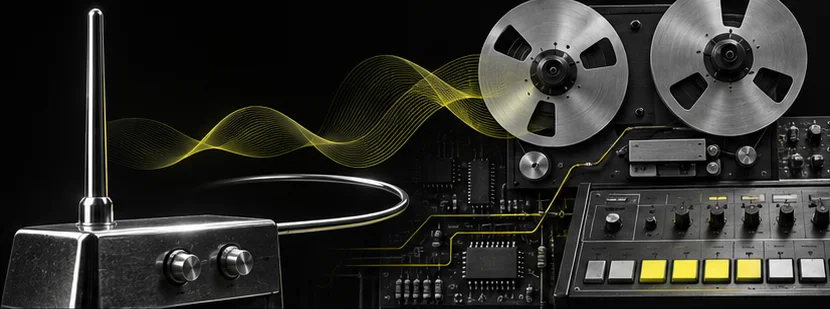
Electronic dance music has a clear family tree: radio studios and Kraftwerk, New York disco clubs, Chicago house and Detroit techno, then the British rave explosion, Berlin after the Wall and the American festival boom. These answers give the dates, places, people and records that matter, in roughly the order they happened.
Key takeaways
- House music grew out of disco in Chicago clubs such as the Warehouse, where Frankie Knuckles was resident DJ from 1977.
- Techno was shaped in Detroit in the 1980s by Juan Atkins, Derrick May and Kevin Saunderson, known as the Belleville Three.
- Phuture’s “Acid Tracks” (Trax Records, 1987) is generally credited as the first acid house record, built on the Roland TB-303.
- Tresor opened in 1991 in the vaults of a former Berlin department store and linked the reunited city with Detroit techno.
- The UK’s Criminal Justice and Public Order Act 1994 targeted outdoor raves playing music of “a succession of repetitive beats”.
On this page
- When did electronic music start?
- Why are Kraftwerk so important to electronic music?
- What was the Paradise Garage and who was Larry Levan?
- How did disco turn into house music?
- What was the Warehouse in Chicago?
- Why is it called house music?
- What was the first acid house record?
- Who are the Belleville Three?
- How did techno start in Detroit?
- What was the Second Summer of Love?
- How did rave culture start?
- What was the Criminal Justice Act 1994 and why did it target raves?
- How did Berlin’s techno scene grow after the Wall fell?
- Where did jungle and drum and bass come from?
- How did EDM become so big in the United States?
Pioneers and disco roots
When did electronic music start?
Electronic music started in the early 20th century with instruments such as the theremin, invented by Léon Theremin in Russia around 1920, and grew after the Second World War in radio studios where composers made music from tape, oscillators and recorded sound.
In Paris in 1948, Pierre Schaeffer created musique concrète, composing with recorded noises, first on disc and then on tape. In Cologne in the early 1950s, the WDR studio, where Karlheinz Stockhausen worked, built music from electronic tones. In London the BBC Radiophonic Workshop, founded in 1958, made sound for radio and television, and Delia Derbyshire’s 1963 realisation of Ron Grainer’s “Doctor Who” theme brought purely electronic music to millions of television viewers. The Moog synthesizer arrived in the mid-1960s, and Wendy Carlos’s “Switched-On Bach” (1968) became a bestseller. The dance music branch grew from these tools in the 1970s.
Why are Kraftwerk so important to electronic music?
Kraftwerk are so important because the Düsseldorf group, founded by Ralf Hütter and Florian Schneider in 1970, made electronic pop from machine rhythms and synthesizers that directly inspired synth pop, the electro sound of early hip hop and Detroit techno.
Their run of albums from “Autobahn” (1974) through “Trans-Europe Express” (1977) and “The Man-Machine” (1978) to “Computer World” (1981) set the template: precise sequenced patterns, robotic vocals and songs about trains, motorways and computers. In New York, Afrika Bambaataa and the Soulsonic Force’s “Planet Rock” (1982) borrowed the melody of “Trans-Europe Express” over a Roland TR-808 beat and helped launch electro. In Detroit, Juan Atkins and Derrick May named Kraftwerk among their biggest influences, alongside the funk of Parliament-Funkadelic. Kraftwerk recorded much of their work in their own Kling Klang studio in Düsseldorf. Start with “Trans-Europe Express” to hear the link to techno.
What was the Paradise Garage and who was Larry Levan?
The Paradise Garage was a members’ club at 84 King Street in New York that ran from the late 1970s until 1987, and Larry Levan was its resident DJ, whose long, emotional sets and remixes shaped disco, early house and the sound later called garage.
Owned by Michael Brody, the Garage was famous for a custom sound system built by Richard Long and for a mostly Black and Latino, largely gay crowd that danced until morning. Levan, who had started out alongside his friend Frankie Knuckles at the Continental Baths, mixed disco, soul, funk, new wave and early electronic records, and remixed or produced tracks such as Taana Gardner’s “Heartbeat” (1981) and the Peech Boys’ “Don’t Make Me Wait” (1982). The word “garage” for soulful, gospel-touched dance music comes from the club’s name. Levan died in 1992, but his way of programming a whole night is still a model for DJs.
How did disco turn into house music?
Disco turned into house music in Chicago in the early 1980s, when DJs kept playing disco after its commercial crash, re-edited it for their dancefloors and added drum machines, until local producers began pressing their own stripped-down, machine-made records around 1984.
Disco’s mainstream backlash peaked at the “Disco Demolition Night” at Chicago’s Comiskey Park on 12 July 1979, but the music lived on in Black and gay clubs. Chicago DJs such as Frankie Knuckles and Ron Hardy extended tracks with reel-to-reel edits and layered beats from drum machines such as the Roland TR-808 and TR-909. Electronic disco had already pointed the way: Donna Summer’s “I Feel Love” (1977), produced by Giorgio Moroder and Pete Bellotte, ran on a synthesizer sequence. Jesse Saunders’ “On and On” (1984) is often cited as the first house record pressed to vinyl, and labels such as Trax and DJ International soon followed.
Chicago house and Detroit techno
What was the Warehouse in Chicago?
The Warehouse was a members’ club in Chicago, opened in 1977, where resident DJ Frankie Knuckles played until the early 1980s to a mostly Black, gay crowd, mixing disco, soul and early electronic records into the style that became house music.
Knuckles had moved to Chicago from New York. At the Warehouse he built long sets from extended edits made on reel-to-reel tape, and later layered a drum machine under the records. In the early 1980s he left to open his own club, the Power Plant, and Ron Hardy’s rawer, wilder sets at the Music Box became the other pole of the scene. Knuckles, later known as the Godfather of House, went on to produce records such as “The Whistle Song” (1991) and died in 2014. The club’s name is also the most widely told origin of the word house, explained in the next answer.
Why is it called house music?
House music is usually said to be named after the Warehouse, the Chicago club where Frankie Knuckles was resident: record shops promoted the records he played there as Warehouse music, and the name was shortened to house.
Knuckles himself told the story this way in interviews, tying the name to a Chicago record shop that stocked the music heard at the club. Other explanations circulate: some Chicago DJs say “house” meant music for house parties, or tracks from a DJ’s own home collection, and both uses may have fed the name. The word became a genre label in the mid-1980s, as Chicago labels such as Trax and DJ International released tracks like Marshall Jefferson’s “Move Your Body” (1986), subtitled “The House Music Anthem”. By the end of the decade, house was the name for the sound across Europe as well as the United States.
What was the first acid house record?
Phuture’s “Acid Tracks”, released on Trax Records in Chicago in 1987, is generally credited as the first acid house record: a long, hypnotic track built on the squelching, ever-changing bass line of a Roland TB-303.
Phuture were DJ Pierre, Spanky and Herb J, and before the record came out, Ron Hardy played a tape of the track at the Music Box. The TB-303 had been sold as a bass accompaniment machine and flopped, so second-hand units were cheap; turning its filter cutoff and resonance in real time gave acid its character. Earlier records had used the machine in a similar way: Charanjit Singh’s “Synthesizing: Ten Ragas to a Disco Beat” (1982), recorded in India, is often cited as a forerunner. Acid house reached Britain in 1987 and 1988. The production basics explain the TB-303 and its partners.
Who are the Belleville Three?
The Belleville Three are Juan Atkins, Derrick May and Kevin Saunderson, friends from Belleville, a small town near Detroit, who are credited with creating Detroit techno in the 1980s and founding its first key labels: Metroplex, Transmat and KMS.
The three met as teenagers in Belleville and shared records and ideas. Atkins came first: with Rick Davis as Cybotron he released “Clear” (1983), and as Model 500 he put out “No UFO’s” (1985) on his own Metroplex label. May, recording as Rhythim Is Rhythim, released “Strings of Life” (1987) on Transmat, one of the most loved records in dance music. Saunderson’s group Inner City, with the singer Paris Grey, turned Detroit techno into international hits in 1988 with “Big Fun” and “Good Life”. All three became influential DJs in Europe, where techno found its first big audience.
How did techno start in Detroit?
Techno started in Detroit in the early and mid-1980s, when young Black producers combined Kraftwerk’s machine music, funk, electronic disco and Chicago house with a futurist outlook shaped by the city’s car industry and its decline, making records with drum machines and synthesizers.
Local radio was a key influence: the Detroit DJ the Electrifying Mojo played Kraftwerk, Parliament-Funkadelic, Prince and new wave side by side. Juan Atkins drew ideas from Alvin Toffler’s book “The Third Wave”, which wrote of “techno rebels”. The name was fixed in 1988 by a British compilation of Detroit tracks with techno in its title, compiled by Neil Rushton for Virgin’s 10 Records label. Detroit techno sounded cooler and more futuristic than Chicago house, though the two scenes traded records and ideas from the start. For the city’s scene since then, see electronic music cities and scenes.
Acid house and rave in Britain
What was the Second Summer of Love?
The Second Summer of Love was the explosion of acid house and Balearic club culture in Britain in 1988 and 1989, named after San Francisco’s 1967 Summer of Love, when new club nights and parties drew huge crowds of young people to dance to house music.
It grew from London nights started after a group of DJs, including Paul Oakenfold and Danny Rampling, returned from Ibiza in 1987 inspired by the eclectic sets they had heard there. Shoom, run by Danny and Jenni Rampling from late 1987, Oakenfold’s Spectrum at Heaven and Nicky Holloway’s The Trip became the defining nights, and the yellow smiley face became the scene’s emblem. Manchester’s Haçienda turned acid house into a northern movement at the same time. The tabloid press soon turned against the culture, and the parties spread from clubs into warehouses and fields. The Ibiza story is told in electronic music cities and scenes.
How did rave culture start?
Rave culture started in Britain in the late 1980s, when acid house parties outgrew the clubs and moved to warehouses, aircraft hangars and fields, often unlicensed, where thousands of people danced all night to house, techno and, soon, homegrown hardcore.
Organisers such as Sunrise and Energy announced parties by flyer and phone line, sending crowds to meeting points along the M25 orbital motorway around London; the duo Orbital took their name from that road. Pirate radio stations spread the music. Parliament responded with the Entertainments (Increased Penalties) Act 1990, which raised fines for unlicensed parties, and the free party movement, with sound systems such as Spiral Tribe, carried on until the Castlemorton Common gathering in Worcestershire in May 1992 drew tens of thousands of people. Rave spread across Europe and North America in the early 1990s, and Berlin’s Love Parade began in 1989.
What was the Criminal Justice Act 1994 and why did it target raves?
The Criminal Justice and Public Order Act 1994 was a UK law that, among much else, gave police powers to stop outdoor gatherings of 100 or more people at night where amplified music was played, defining that music by “a succession of repetitive beats”.
The government brought it in after the free party boom, especially the Castlemorton Common gathering of May 1992. The Act let officers direct people to leave and seize sound equipment, and its wording about repetitive beats was widely mocked. Protest marches took place in London in 1994, and musicians answered too: Autechre’s “Anti EP” on Warp carried a track, “Flutter”, programmed so that no bar repeats. The law pushed much of the scene into licensed clubs, the era of large venues such as London’s Ministry of Sound (opened 1991) and Liverpool’s Cream (1992), while free parties continued on a smaller scale. It is a rare example of a law that describes a musical style.
The 1990s and after
How did Berlin’s techno scene grow after the Wall fell?
Berlin’s techno scene grew after the Wall fell in November 1989 because East Berlin was full of empty buildings with unclear ownership, and young people from both halves of the city turned basements, bunkers and industrial spaces into clubs, with techno as the shared sound of reunification.
Tresor, opened by Dimitri Hegemann in 1991 in the vaults of a former department store near Potsdamer Platz, became the symbol of that moment. Its record label built a direct line to Detroit, releasing artists such as Jeff Mills, whose “Waveform Transmission Vol. 1” came out on Tresor in 1992. The Love Parade, started by Dr. Motte in 1989 as a small street demonstration, grew into one of the world’s largest street parties during the 1990s. Cheap space, loose regulation in the years after reunification and a crowd that mixed East and West Berliners gave the city its long-night club culture. Berlin’s later scene is covered in electronic music cities and scenes.
Where did jungle and drum and bass come from?
Jungle and drum and bass came from London and south-east England in the early 1990s, when producers in the UK rave scene sped up chopped breakbeats and combined them with the heavy bass of reggae sound systems, creating jungle by around 1993 and the smoother drum and bass soon after.
The roots are in UK hardcore of around 1991 and 1992, which pushed breakbeats ever faster. The most famous source break, the “Amen break”, comes from the Winstons’ 1969 B-side “Amen, Brother”. Jungle added ragga vocals and dub bass and was spread by pirate radio stations such as Kool FM. By the mid-1990s drum and bass had emerged as a sleeker, more technical form: Goldie’s album “Timeless” (1995), LTJ Bukem’s Good Looking label and Roni Size and Reprazent’s “New Forms”, which won the Mercury Prize in 1997, took it to a wider audience. The drum and bass vs jungle comparison explains how the two differ.
How did EDM become so big in the United States?
EDM became big in the United States in the late 2000s and early 2010s, when festival-scale dance music merged with pop: producers such as David Guetta and Calvin Harris made hits with pop and hip hop stars, and festivals such as Ultra and Electric Daisy Carnival grew into huge events.
Daft Punk’s pyramid show at Coachella in 2006 is often cited as a turning point for American audiences. David Guetta co-produced the Black Eyed Peas’ “I Gotta Feeling” (2009), Avicii’s “Levels” (2011) became a global anthem, and in 2012 Skrillex won three Grammy Awards. Electric Daisy Carnival moved to Las Vegas in 2011, and the city’s clubs and hotels booked star DJs for residencies. YouTube, SoundCloud and social media helped a young audience find the music outside radio. The boom gave “EDM” its narrow meaning of mainstage pop-dance, distinct from underground house and techno. The EDM vs techno comparison sets out the differences.
Read next
On air now
The quickest way into electronic music is to listen.
Radio Glamorize streams deep house, dub techno, electronica and ambient 24/7, with no ad breaks. Free in the browser, no app needed.


