


Clubbing Guide: Techno Clubs, Festivals and Dancefloor Etiquette
Resources / Field notes / Clubbing
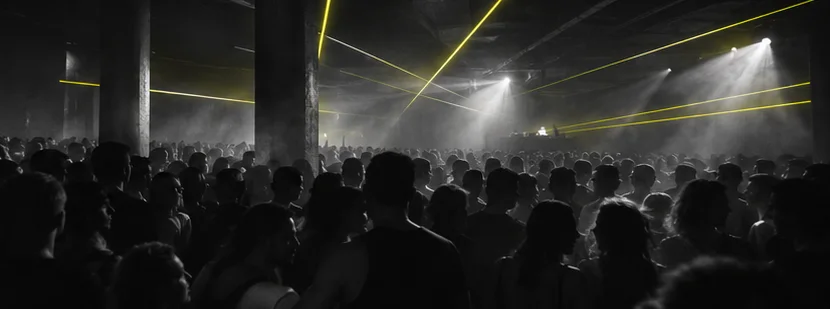
Club culture has its own unwritten rules, from why the night starts after midnight to why phones stay in pockets. This field note explains what to expect at a first techno night, how doors and etiquette work, how to protect your hearing and which festivals shaped electronic dance music. Venues and policies differ, so treat it as general guidance and check each event’s own information.
Key takeaways
- Many techno nights peak somewhere between about 1 and 4 am, so arriving early means hearing the warm-up DJ and a shorter queue.
- Some clubs ban photos to protect guests’ privacy and keep attention on the music and the dancefloor.
- Earplugs with flatter attenuation lower the volume evenly across frequencies, so music stays clear while your hearing is protected.
- Sónar and Time Warp began in 1994, Amsterdam Dance Event in 1996, Awakenings in 1997 and Detroit’s Movement in 2000.
- Requesting songs is generally not done at underground clubs; ask for a track ID politely after the set instead.
On this page
- What should I expect at my first techno club night?
- Why do club nights start so late?
- What should I wear to a techno club?
- How do club door policies work?
- What is good etiquette on a techno dancefloor?
- Why do some clubs ban photos and phones?
- Can I request a song from a techno DJ?
- What is the difference between a club night, a rave and a festival?
- Which electronic music festivals are the most influential?
- What are open airs and day parties?
- How do I find underground electronic music parties?
- How do I protect my hearing at clubs and festivals?
- Is it okay to go clubbing alone?
- How can I stay safe at a club or festival?
Your first club night
What should I expect at my first techno club night?
At a first techno club night, expect a dark room, a loud sound system, long DJ sets that build slowly over hours, and a crowd that comes mainly to dance rather than to watch the DJ.
Doors often open around 23:00 or midnight, the main room fills after 1 am, and the night can run until morning or, in cities such as Berlin, well into the next day. DJs mix continuously, so there are few obvious song changes or pauses. Bring ID, a card and some cash, and earplugs; check the event page for age limits and whether there is a cloakroom. A common misconception is that the headliner is the whole night: the warm-up DJ sets the mood, and arriving early is the easiest way to get in and find your place on the floor. Unfamiliar terms are explained in the DJ glossary.
Why do club nights start so late?
Club nights start late because electronic dance music is built around a long night, with a warm-up DJ, a peak-time set and a closing set, and the peak usually falls somewhere between about 1 and 4 am.
Local habits play a part too. In Spain and much of southern Europe people eat late and go out after midnight, and in Berlin many clubs run from Saturday night into Sunday or beyond. Licensing rules set the limits: where clubs must close at 3 or 4 am, nights tend to start earlier. Headliners usually play the peak slot, but some clubs do not publish set times, so that the room fills for every DJ rather than for one name. A practical tip: if set times are published, plan around them; if not, arrive early, hear the warm-up and pace yourself for the hours ahead.
What should I wear to a techno club?
For a techno club, wear comfortable, casual clothes you can dance in for hours, usually in dark or neutral colours, with flat shoes that are already broken in, since many techno venues care more about attitude than fashion.
Clubs get hot on the dancefloor and cold in the queue, so layers and zipped pockets work better than a heavy coat, especially if there is no cloakroom. At selective doors, clothes that look chosen for photos rather than for dancing can count against you, though no outfit guarantees entry. Themed nights, queer parties and fetish events can have their own dress codes, which are stated on the event page, so read it before you go. A practical tip: shoes matter most, since you may stand and dance for five or six hours, and a small bag you can wear across your body keeps your hands free.
How do club door policies work?
Club door policies decide who gets in: door staff check age and ID, refuse people who are visibly drunk or aggressive, and at selective clubs also choose guests to protect the mood and safety of the night.
Selective doors became famous in Berlin, where Berghain has long been known for turning many people away, but the logic is common: a door is trying to build a crowd that will dance, respect others and keep the space safe, especially for queer and minority guests. Large groups, loud queues and people who seem to have come only to see the club are refused more often. Some venues use guest lists, membership or advance tickets instead. Nobody can guarantee entry, and door staff rarely explain a refusal. A practical tip: know who is playing, keep your group small, stay calm and sober in the queue and accept a no politely.
Etiquette on the dancefloor
What is good etiquette on a techno dancefloor?
Good etiquette on a techno dancefloor means giving people space to dance, keeping your phone in your pocket, moving off the floor to talk, and not pushing through the crowd or crowding the DJ booth.
Most of the rules come from respect: people come to lose themselves in the music, and the person in front of you has as much right to the space as you do. Keep conversations for the bar or the smoking area, since talking near the speakers disturbs others and you will not hear each other anyway. Ask before touching anyone and look out for the people around you. Never put drinks on the DJ booth or reach for the equipment, and cross the floor along its edges. A practical tip: if someone is bothering you or another guest, tell the staff or the venue’s awareness team rather than handling it alone.
Why do some clubs ban photos and phones?
Some clubs ban photos and phone use on the dancefloor to protect guests’ privacy, so people can dance and dress freely without appearing online, and to keep attention on the music instead of on screens.
The policy is closely linked with Berlin, where door staff at several clubs have long put stickers over phone cameras at the entrance, and it has spread to clubs and parties in other cities. At queer and fetish nights in particular, being photographed can carry real risks, so a no-photo rule is a safety measure as much as a style choice. Many promoters also say that a crowd without raised phones dances more and stares less at the DJ. Breaking the rule can get you removed from the venue. A practical tip: if you want to remember the night, note the DJ’s name and the time and look up the set later.
Can I request a song from a techno DJ?
Requesting a song from a techno or house DJ is generally not done at underground clubs, because the DJ is building a set with its own flow, and asking for a specific track interrupts them while they mix.
Club DJs prepare a selection and read the room, and many will not have your track with them, especially if it is a pop song. Wedding, bar and mobile DJs are different, and requests are part of their job. If a track excites you, the better move is to ask for the track ID after the set or by messaging the DJ later, or to look up the set’s tracklist online. Never lean into the booth or touch the equipment. A practical tip: note the time a track played, which makes it much easier for the DJ or other listeners to identify a track from a DJ set.
Festivals, raves and open airs
What is the difference between a club night, a rave and a festival?
A club night is a regular event in a licensed venue with set hours, a rave historically meant an unlicensed party in a warehouse or field, and a festival is a larger event with several stages over one or more days.
The modern sense of rave comes from the UK’s late 1980s acid house parties, many of them held illegally in warehouses and fields around the M25. Today the word is used loosely for any big dance party, including licensed ones, and in some countries it still describes free parties. Festivals grew out of both worlds in the 1990s, bringing many artists together with camping, art and daytime programmes. Each format plays differently: a club night lets one or two DJs build long sets, while festival slots often last 60 to 90 minutes. For the story of rave culture, see the history of electronic dance music.
Which electronic music festivals are the most influential?
Influential electronic music festivals include Sónar in Barcelona and Time Warp in Germany, both founded in 1994, Amsterdam Dance Event (1996), Awakenings in the Netherlands (1997), Detroit’s Movement (2000), Tomorrowland in Belgium (2005) and Dekmantel in Amsterdam (2013).
Each shaped the scene in a different way. Sónar paired music with digital art and technology across daytime and night-time programmes. Time Warp became a landmark indoor techno event in Mannheim. ADE, held each October, is both an industry conference and a city-wide festival. Awakenings grew into one of the largest techno festivals, and Movement, which began as the Detroit Electronic Music Festival, celebrates the city where techno was born. Tomorrowland brought large-scale stage production to EDM, and Dekmantel built a reputation for adventurous programming. Dates, line-ups and tickets change every year, so check each festival’s official information.
What are open airs and day parties?
Open airs are outdoor electronic music parties held in parks, gardens, beaches or courtyards, and day parties are events that run in daylight hours, usually from the afternoon into the evening, instead of overnight.
Berlin’s summer open airs, Ibiza’s daytime parties and beach events around the Mediterranean made the formats popular, and many cities hold Sunday afternoon parties for people who would rather sleep at night. The music often starts warm and melodic, with deep house, disco and Balearic sounds, and builds as the sun goes down. Outdoor events usually have noise curfews, so they tend to end earlier than clubs. A practical tip: plan for the weather, with water, sun protection and a layer for the evening, and check whether re-entry is allowed before you leave the site.
How do I find underground electronic music parties?
To find underground electronic music parties, follow local promoters, collectives, resident DJs and record shops, since many smaller events are announced on their own channels or by word of mouth rather than through large ticket platforms.
Start with the DJs you already like: check where they play, who books them and which collectives they belong to. Event listing sites such as Resident Advisor cover many club scenes, and local record shops, community radio stations and their DJs often know about smaller nights. Some parties publish the location only after you buy a ticket or join a mailing list, which keeps numbers manageable and the crowd committed. Treat unlicensed events with care: check how you will get home, where the exits are and whether there is any first aid. A practical tip: go to the same night more than once, since regulars usually hear about the next party first.
Hearing protection and staying safe
How do I protect my hearing at clubs and festivals?
To protect your hearing at clubs and festivals, wear earplugs designed for music, which lower the volume evenly across frequencies, take regular breaks in quieter areas, and keep your distance from the speakers.
Club sound can reach 100 decibels or more, and the risk grows with both level and time, so a long night next to the stacks adds up. Foam earplugs block a lot but muffle the treble, while high-fidelity or musician’s earplugs have flatter attenuation, often around 15 to 25 dB, so the music stays clear, just quieter. Custom-moulded plugs made from an impression of your ear fit most closely. Ringing or dull hearing after a night is a sign your ears have had too much. A practical tip: put earplugs in before the music gets loud and keep them in, because loud sound seems quieter once your ears adapt, which makes the level easy to underestimate.
Is it okay to go clubbing alone?
Going clubbing alone is common at techno and house nights, where many people come to dance rather than to socialise, and it lets you follow the music, arrive and leave when you like and meet people on the dancefloor.
Many people find they listen more closely on their own and talk to more strangers than they would in a group. A few habits make it easier: tell a friend where you are going and when you expect to be home, keep your phone charged, plan your route back and keep your drink with you. When you arrive, find the exits, toilets, water and staff. At a selective door, arriving alone often counts in your favour compared with a loud group. A practical tip: choose a night with a DJ you already know, so the music gives you a reason to stay before you have met anyone.
How can I stay safe at a club or festival?
To stay safe at a club or festival, go with friends or keep someone informed, agree a meeting point, drink water regularly, know where staff and first aid are, and plan how you will get home before you set out.
Phone signal often fails in crowds, so a fixed meeting point and a time to check in work better than messages. Keep valuables in a zipped pocket and your drink in your hand. If you or someone else feels unwell, overheated or unsafe, go to venue staff, security or the welfare or first aid team straight away: they are there to help. Look out for friends who wander off alone, and do not leave anyone behind who is struggling. A practical tip: save the venue’s address and your route home on your phone, and keep some money aside for a taxi in case public transport stops for the night.
Read next
On air now
The quickest way into electronic music is to listen.
Radio Glamorize streams deep house, dub techno, electronica and ambient 24/7, with no ad breaks. Free in the browser, no app needed.


