


Istanbul Electronic Music: Inside Turkey’s Club and DJ Scene
Resources / Field notes / Istanbul
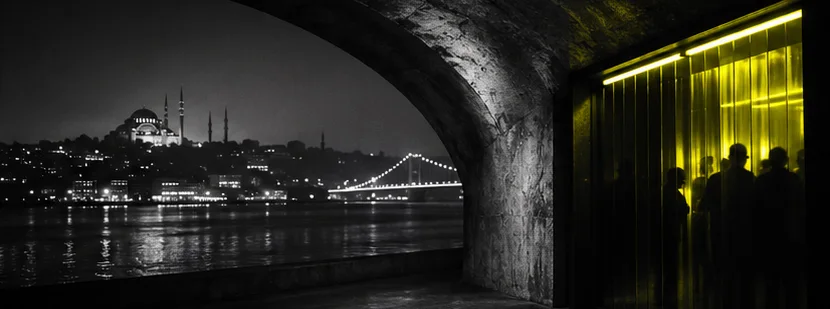
Istanbul sits between Europe and Asia, and its electronic music borrows from both: four-on-the-floor club rhythms meet the oud, the ney and the scales of Turkish music. This field note covers how the city’s scene grew, the local sounds DJs reach for, the Turkish artists heard abroad and how to follow Istanbul DJs live. Radio Glamorize is based in Istanbul, so this is our home scene.
Key takeaways
- Istanbul’s club culture grew from the 1990s, and by the 2000s the city was a regular stop for touring international DJs.
- Oriental or ethnic deep house sets oud, ney and darbuka-style percussion over steady deep house grooves of around 120 BPM.
- DJs re-edit 1960s and 1970s Anatolian rock, extending its grooves and breaks so the records work on a dancefloor.
- Mercan Dede blends the ney and Sufi music with electronic beats, while Baba Zula mixes Istanbul psychedelia with dub.
- Turkey has stayed on UTC+3 all year since 2016, so Istanbul show times never shift for daylight saving.
On this page
- What is Istanbul’s electronic music scene like?
- How did electronic music grow in Istanbul?
- What is Turkey’s summer open-air party scene like?
- What is oriental or ethnic deep house?
- Why do DJs play re-edits of Anatolian rock and Turkish psych?
- What is Sufi electronic music?
- Which Turkish instruments are used in electronic music?
- Which Turkish electronic artists are known abroad?
- Who were the pioneers of Anatolian rock?
- What is the film Crossing the Bridge: The Sound of Istanbul?
- What time zone do Istanbul radio shows use?
- Where can I hear Istanbul DJs online?
- How do I find Turkish electronic music to stream or buy?
Istanbul’s electronic music scene
What is Istanbul’s electronic music scene like?
Istanbul’s electronic music scene is large and varied, running from deep house and melodic sounds to hard-edged techno, and it is shaped by the city’s position between Europe and Asia and by Turkish musical traditions.
Istanbul nightlife has historically centred on the European side, around Beyoğlu and the Bosphorus shore, though parties happen on both continents. Clubs, bars, rooftops and one-off warehouse events have all played a part, and venues change often, so local promoters and listings are the most reliable guide to what is on. A common misconception is that Turkish electronic music means only oriental deep house: Istanbul DJs play the full range, from minimal and dub techno to disco and Anatolian psych edits. In summer much of the scene moves to the coast. A practical tip: follow resident DJs and promoters rather than buildings, because people outlast venues.
How did electronic music grow in Istanbul?
Electronic music grew in Istanbul from the 1990s onwards, as club nights, local DJs and imported records took hold, and by the 2000s the city had become a regular stop for international DJs on tour.
The early scene was small: a handful of clubs and bars, and DJs who brought records back from trips abroad and built crowds for house and techno. Through the 2000s larger venues and festivals made Istanbul a recognised destination, and a generation of Turkish DJs and producers began releasing on foreign labels. In the 2010s smaller underground parties in industrial spaces and on rooftops grew alongside the big rooms, and Turkish producers found international audiences for deep house and melodic styles. This history is mostly told through people rather than documents, so treat claims about who did something first with caution. For the wider picture, see electronic music cities and scenes.
What is Turkey’s summer open-air party scene like?
Turkey’s summer open-air party scene moves much of Istanbul’s nightlife to the Aegean and Mediterranean coasts, where beach clubs, sunset sessions and outdoor parties run through the warm months, often from late afternoon into the night.
Resort towns such as Bodrum and Çeşme have long drawn DJs and crowds from Istanbul in July and August, and many Istanbul DJs follow their audience to the coast for the season. The music tends to suit the setting: deep house, melodic and organic house, downtempo and disco around sunset, with harder sounds later. Line-ups and venues change every year, so check local listings close to the date rather than relying on last summer’s names. A practical point for outdoor events in the Turkish summer: heat and sun are the main hazard in the afternoon, so bring water, a hat and sunscreen and pace yourself until the evening cools.
Turkish sounds in electronic music
What is oriental or ethnic deep house?
Oriental or ethnic deep house is deep house that adds Middle Eastern and Turkish elements, such as oud, ney or kanun melodies, darbuka-style percussion and vocals in Turkish, Arabic or other languages, over a steady groove of around 120 BPM.
The style became widely popular in Turkey and the wider region in the 2010s, through club play, beach bars and online channels that post long compilations under names such as “ethnic deep house” and “oriental house”. Melodies often use scales close to the Hicaz makam, whose augmented second gives much Middle Eastern music its character to Western ears. The tags overlap with organic house and Afro house, and the borders between them are loose. “Oriental” is a marketing label rather than a precise genre, and some listeners find it dated, so expect several names for the same sound. For the base style, see the deep house and dub techno guide.
Why do DJs play re-edits of Anatolian rock and Turkish psych?
DJs play re-edits of Anatolian rock and Turkish psych because the 1960s and 1970s records have heavy grooves, fuzz guitar, electric saz and strong vocals, and an edit loops and extends those parts so the music can be mixed in a club.
Anatolian rock combined Turkish folk melodies and instruments with Western rock, funk and psychedelia, and from the 2000s reissue labels in Europe and the US introduced it to a new audience. Edits usually lengthen the intro and outro, loop the drum breaks and sometimes add a straight kick, and they often sit somewhere around 100 to 120 BPM. They suit warm-up sets, slower cosmic and Balearic-leaning sets and sunset slots. A common misconception is that an edit is a remix: an edit rearranges the original recording rather than rebuilding it from new parts. An edit of someone else’s record still needs the rights holders’ permission before it can be released and sold.
What is Sufi electronic music?
Sufi electronic music combines the music of Sufi traditions, especially the ney flute, frame drums and devotional vocals associated with the Mevlevi order, with electronic beats, ambient textures and dance rhythms.
In Turkey the most widely known figure is Mercan Dede, a DJ, producer and ney player whose albums and concerts mix Sufi melodies, and often a whirling dancer on stage, with downtempo, house and electronic production. The Mevlevi order, which grew from the teachings of the 13th-century poet Rumi in Konya, gave the ney a central place, and its breathy tone suits long, slowly unfolding tracks. The style overlaps with downtempo, organic house and world fusion rather than forming one strict genre. A note on context: the sema is a religious ceremony, so Sufi-inspired music deserves to be presented with care rather than used as club decoration.
Which Turkish instruments are used in electronic music?
The Turkish instruments most used in electronic music are the oud, the ney, the bağlama or saz, the darbuka and the kanun, either sampled or played live over house, downtempo and organic electronic grooves.
The oud is a fretless short-necked lute with a warm, plucked tone; the ney is an end-blown reed flute with a breathy sound; the bağlama, the most common type of saz, is a long-necked lute central to Turkish folk music; the darbuka is a goblet drum with a deep “dum” and a sharp “tek”; and the kanun is a plucked zither. Frame drums such as the bendir add low pulses. Many of these instruments play intervals that fall between the notes of a Western piano, so producers either tune samples carefully or let the microtones stand. A practical tip: record or choose samples that are dry, then add reverb in the mix so the instrument sits with the beat.
Turkish artists and records known abroad
Which Turkish electronic artists are known abroad?
Turkish electronic artists known abroad include Mahmut Orhan, Burak Yeter, Mercan Dede, Baba Zula, Barış K and Ah! Kosmos, who between them cover deep house, dance pop, Sufi fusion, Istanbul psychedelia, edits and experimental electronica.
Mahmut Orhan reached a wide audience in the mid-2010s with “Feel”, featuring the singer Sena Şener, and Burak Yeter had an international dance hit with “Tuesday”, featuring Danelle Sandoval. Mercan Dede took ney-led Sufi electronica to concert stages around the world, and Baba Zula, formed in Istanbul in the 1990s, blends electric saz, dub and psychedelia. Barış K, an Istanbul DJ, is known abroad for edits and DJ sets that often draw on Turkish and other regional records, and Ah! Kosmos makes experimental electronic music in Istanbul. Many more Turkish DJs work locally or abroad. A practical tip: start with these names, then follow their remixers, collaborators and labels.
Who were the pioneers of Anatolian rock?
The pioneers of Anatolian rock include Erkin Koray, Cem Karaca, Barış Manço, Selda Bağcan and the group Moğollar, who in the 1960s and 1970s combined Turkish folk music with rock, psychedelia and funk.
Erkin Koray is often called one of the first Turkish rock musicians and was known for fuzz-heavy guitar. Cem Karaca and Barış Manço each worked with several bands and drew directly on Anatolian folk songs, while Selda Bağcan’s protest songs set a powerful voice over saz and electric backing. Moğollar brought Turkish instruments into a rock line-up. These records are the source material for many of today’s edits, and newer acts such as Altın Gün, a band formed in Amsterdam, and the Istanbul singer Gaye Su Akyol carry the sound forward. A practical tip: start with reissues and compilations, which usually include liner notes on who played what.
What is the film Crossing the Bridge: The Sound of Istanbul?
Crossing the Bridge: The Sound of Istanbul is a 2005 documentary by Fatih Akın in which Alexander Hacke of Einstürzende Neubauten records Istanbul musicians across rock, hip hop, electronic, folk and classical Turkish styles.
The film features, among others, Baba Zula, the electronic fusion group Orient Expressions, the rapper Ceza and the singer Sezen Aksu, and it shows how Istanbul musicians move between Turkish traditions and Western forms. For listeners abroad it is one of the easiest introductions to the city’s music, because it puts underground and mainstream artists side by side and lets them explain their own work. A useful way to watch it is as a map: note the names that catch your ear, then look up their albums and collaborators, which leads quickly to the Istanbul electronic and fusion artists of the 2000s.
Listening to Istanbul DJs from anywhere
What time zone do Istanbul radio shows use?
Istanbul radio shows use Turkey Time, UTC+3, all year round, because Turkey stopped changing its clocks in 2016, so a show at 21:00 in Istanbul always starts at 18:00 UTC.
For listeners in Europe and North America the gap changes twice a year on their side, not Istanbul’s. A 21:00 Istanbul show starts at 18:00 in London in winter and 19:00 in summer, and at 19:00 in Berlin in winter and 20:00 in summer. Radio Glamorize lists its programmes in GMT+3 on its weekly show schedule, so add or subtract your own offset from those times. A simple tip: add Istanbul as a second clock on your phone, which removes the arithmetic. The radio shows field note has a full city-by-city conversion table for an evening show.
Where can I hear Istanbul DJs online?
You can hear Istanbul DJs online on Radio Glamorize, an independent, ad-free electronic music station based in Istanbul that broadcasts 24 hours a day with resident DJs, many from the Turkish scene, and guest shows.
Listen live with the LISTEN button on radioglamorize.com, the popup player in a browser tab with no app, or the station’s Android and iOS apps. The weekly schedule, in GMT+3, shows which programme is on air, and recorded mixes are available on demand in the DJ sets archive, with DJ performances and radio sets in the video archive. The team page introduces the people behind the station. Many Istanbul DJs also post mixes on their own pages. A practical tip: when a DJ catches your ear, note the show and the time, then look for more of their sets in the archive.
How do I find Turkish electronic music to stream or buy?
To find Turkish electronic music, search for style tags such as “oriental deep house”, “Anatolian psych edit”, “Turkish psych” and “Sufi electronic”, then follow the artists, labels and DJs that keep appearing in the credits and tracklists.
On download stores and Bandcamp, labels are the most reliable thread: once you find a record you like, look at the label’s other releases and the remixers it uses. Discogs lists Turkish pressings, reissues and the musicians on them, which helps with older Anatolian records. Searching in Turkish also helps: terms such as “Anadolu rock” and “elektronik müzik”, and artist names spelled with ı, ş and ğ, often return different results from the English spelling. A misconception to avoid is that every track tagged “Turkish” comes from Turkey, since the tag is often a style label. More methods are in how to find new electronic music.
Read next
On air now
The quickest way into electronic music is to listen.
Radio Glamorize streams deep house, dub techno, electronica and ambient 24/7, with no ad breaks. Free in the browser, no app needed.


