


Vinyl, CDJs and Audio Files: DJ Formats Explained
Resources / Field notes / Formats
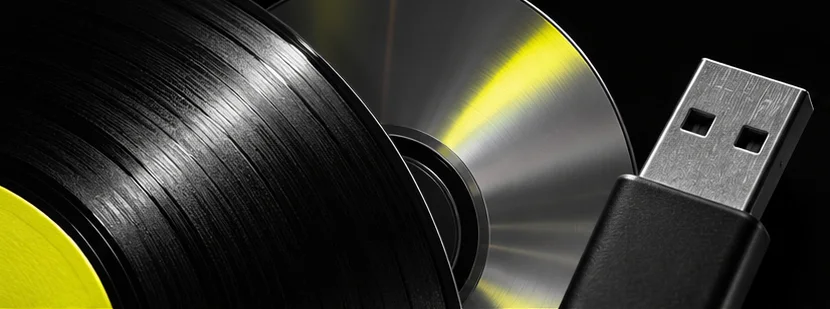
DJs have played vinyl, CDs, timecode records and USB drives, and every one of those formats still has a place in some booth. This page explains where the 12-inch single and the CDJ came from, why the Technics SL-1200 became the standard turntable, how the main audio files differ, and how DJs use test pressings, Discogs and record pools.
Key takeaways
- The 12-inch single grew out of disco in the mid-1970s, and mixer Tom Moulton is credited with the idea.
- Technics introduced the SL-1200 in 1972; the SL-1200MK2 of 1979 became the standard club turntable.
- Pioneer’s first CDJ, the CDJ-500, appeared in 1994, and the CDJ-1000 of 2001 brought a vinyl-like jog wheel.
- WAV and AIFF are uncompressed, FLAC is lossless compressed and MP3 is lossy; 320 kbps is the highest standard MP3 bitrate.
- Discogs, founded in 2000 in Portland, Oregon, began as a database of electronic music releases.
On this page
- Why do DJs still use vinyl?
- Who invented the 12-inch single?
- What is the difference between 33 and 45 RPM records?
- Why is the Technics SL-1200 the standard DJ turntable?
- What was the first CDJ?
- What is DVS in DJing?
- What is the difference between WAV, AIFF, FLAC and MP3?
- Is MP3 good enough to play in a club?
- How do I digitise my vinyl records?
- What is a test pressing?
- What is Discogs and how do DJs use it?
- What is a record pool for DJs?
Vinyl and turntables
Why do DJs still use vinyl?
DJs still use vinyl because many house, techno and other underground releases appear on vinyl first or only, because mixing by hand on turntables feels direct, and because records make a physical, lasting collection.
Playing records demands close attention: there is no waveform and no sync, so you beatmatch by ear and learn every record by its grooves and its label. Many DJs also value the limits, since a bag of 80 records makes selection deliberate. A common misconception is that vinyl always sounds better than digital. Vinyl has its own character, but it also has surface noise, a smaller dynamic range than a good digital file, and practical limits, such as bass that must be kept close to mono and treble that suffers near the centre of a side. Tip: before playing vinyl in a club, ask whether the turntables are set up and the mixer has working phono inputs.
Who invented the 12-inch single?
The 12-inch single is credited to disco mixer Tom Moulton in the mid-1970s, after a reference disc cut on a larger blank than the usual 7-inch showed that spreading the grooves wider gave a louder, fuller sound.
Wider grooves allow a higher cutting level and deeper bass, which suited the extended disco mixes DJs wanted. Early 12-inch singles went to DJs as promotional copies, and Salsoul Records’ 1976 release of Double Exposure’s ‘Ten Percent’, mixed by Walter Gibbons, is often cited as the first 12-inch single sold commercially. The 12-inch then became the standard format for disco, house, techno and most club music, usually carrying one track per side at 45 RPM, or two or more per side at 33⅓ RPM. Tip: on second-hand dance 12-inches, check the label or the run-out area for the playing speed before you blame the pressing for sounding wrong.
What is the difference between 33 and 45 RPM records?
33⅓ RPM is the standard speed for LPs and longer EPs, while 45 RPM is used for 7-inch singles and many dance 12-inches, because the faster speed gives better treble and louder levels at the cost of playing time.
At 45 RPM the groove passes the stylus 35 per cent faster, so the same stretch of time is spread over more groove and the cutting engineer can push the level and the bass harder. That is why a dance single with one track per side is often cut at 45, while a four-track EP or an album side usually needs 33⅓ to fit. Playing a record at the wrong speed changes tempo and pitch together: a 125 BPM track cut at 45 plays at about 93 BPM at 33⅓. Some DJs do this on purpose, playing a 45 at 33 with the pitch raised for a slower, heavier groove. Tip: if a record sounds oddly slow and deep, check the speed button first.
Why is the Technics SL-1200 the standard DJ turntable?
The Technics SL-1200 became the standard DJ turntable because its strong direct-drive motor, stable speed, pitch fader of plus or minus 8 per cent and very durable build suited club use, especially from the SL-1200MK2 of 1979.
Technics, a brand of Matsushita (now Panasonic), introduced the SL-1200 in 1972 as a hi-fi turntable. The MK2 added a long pitch slider with a quartz-locked centre position, and DJs found that its high-torque motor reached speed almost at once and held it when they nudged or held the platter. It became the default in clubs and in DJ battles for decades. Production stopped in 2010, and Technics revived the line in 2016. Tip: on any turntable, check that the pitch is set to zero and that the counterweight and anti-skate are adjusted for your cartridge before you blame a record for skipping.
CDJs, DVS and digital audio files
What was the first CDJ?
The first CDJ was the Pioneer CDJ-500, released in 1994, a CD player with tempo control and a jog wheel designed for DJs, and Pioneer’s later CDJ models became standard equipment in club booths.
CDJs let DJs play their own CD-Rs of new and unreleased tracks without pressing vinyl, although many DJs disliked their feel at first. The CDJ-1000 of 2001 changed that with a large jog wheel that responded to touch like a record, and it spread quickly through clubs. The CDJ-2000 of 2009 made USB drives prepared in rekordbox the normal way to carry music, and later models, including the CDJ-3000 of 2020, continued that approach. The CDJ-3000 has no disc drive at all, yet the name stayed. Tip: before playing a club, find out which player models are in the booth and test your USB drive on similar ones.
What is DVS in DJing?
DVS, or digital vinyl system, lets DJs control digital files on a computer with turntables or CDJs, using timecode records or CDs whose signal tells the software the speed, direction and position.
A timecode record looks like normal vinyl but carries a control tone instead of music; the software reads it through an audio interface or a compatible mixer and plays the digital track to match, so scratching and nudging work as they do on vinyl. Final Scratch, released by Stanton in the early 2000s, was the first widely known system, and Serato Scratch Live, developed with Rane, made DVS common in clubs and in scratch DJing from the mid-2000s. Traktor and rekordbox later offered their own versions. Tip: carry spare timecode records and know how to switch the software to its internal playback mode, so a skipping needle does not stop the music.
What is the difference between WAV, AIFF, FLAC and MP3?
WAV and AIFF are uncompressed audio files, FLAC is lossless compressed audio that decodes to exactly the same sound in a smaller file, and MP3 is lossy, discarding data the ear is less likely to notice.
A CD-quality WAV or AIFF file runs at 1,411 kbps, about 10 MB per minute, while a 320 kbps MP3, the highest standard MP3 bitrate, is under a quarter of that size. FLAC typically shrinks a file to roughly half to two thirds of its WAV size with no loss. For DJs the practical differences are compatibility and tags: AIFF stores artist, title and artwork more reliably than WAV in many DJ programs, and some older club players do not read FLAC. That is why many DJs buy WAV or AIFF and keep AIFF as their working format. Tip: never convert an MP3 to WAV to improve it, because the discarded data does not come back.
Is MP3 good enough to play in a club?
A 320 kbps MP3 is good enough for most club systems and very hard to tell apart from a lossless file, but low-bitrate MP3s such as 128 kbps files can sound harsh and smeared on a large sound system.
Lossy encoding throws away detail that a big, loud system can expose: cymbals that swirl, reverb tails that turn grainy and a stereo image that feels narrower. At 320 kbps those artefacts are rare, which is why many professional DJs have played MP3s for years without complaint, but they become audible as the bitrate falls. Files taken from streams or video sites are usually low quality as well as unlicensed, so they have no place in a set. Tip: buy lossless when a store offers it, treat 320 kbps MP3 as your minimum, and check doubtful files in an audio editor’s spectrum view, because an MP3 re-encoded at a higher bitrate still carries the damage of its first encoding.
Pressings, digitising, Discogs and record pools
How do I digitise my vinyl records?
To digitise vinyl, play the cleaned record on a well-adjusted turntable through a phono preamp into an audio interface, record it at 24-bit resolution in an audio editor, then split, tidy and tag the tracks.
Clean the record and the stylus first, because every click you avoid is one you do not have to repair later. A turntable’s phono signal is very quiet and needs RIAA equalisation, so it must pass through a phono preamp, a DJ mixer’s phono input or a turntable with a built-in preamp. Record at 24-bit and 44.1 or 48 kHz, with peaks well below 0 dBFS to leave headroom. Save the results as WAV, AIFF or FLAC, use click removal sparingly, and tag each file with the label and catalogue number. Copying rules for personal use differ by country, so check yours, and keep the files for your own use.
What is a test pressing?
A test pressing is one of a small number of records pressed from new stampers before the main run, so the artist, label and mastering engineer can check sound and faults before approving production.
Vinyl manufacturing goes from a master lacquer to metal parts and stampers, and problems such as noise, distortion, skips or a quiet side often show up only on the first discs. Test pressings, usually in plain sleeves with a blank or handwritten label, are played and either approved or rejected, in which case the fault is corrected and new tests are made. Because so few exist, test pressings of well-known club records are collectable. A test pressing differs from a white label: the test checks the manufacturing, while a white label is a promotional or small unofficial release. Tip: when buying one second-hand, compare the run-out etching with the released version.
What is Discogs and how do DJs use it?
Discogs is an online database and marketplace for physical music releases, founded in 2000 by Kevin Lewandowski in Portland, Oregon, and DJs use it to identify pressings, check credits and buy records.
Discogs began as a database of electronic music before expanding to every genre, and its entries are written by users, who list labels, catalogue numbers, credits, formats and the run-out etchings that tell pressings apart. DJs use it to trace a producer’s other work, explore a label’s back catalogue and find second-hand copies from sellers in many countries. Condition is graded on a scale running from Mint and Near Mint through Very Good Plus and Very Good down to Poor, with record and sleeve graded separately. Tip: before buying, read the seller’s condition notes and compare the catalogue number with the release page, because represses and bootlegs can look alike.
What is a record pool for DJs?
A record pool is a membership service that supplies DJs with promotional music from labels, today mostly as downloads for a subscription, traditionally in return for feedback on how the tracks work on the dancefloor.
Record pools began in New York in the mid-1970s, when disco DJs, with David Mancuso among the founders, organised to receive promotional records from labels collectively rather than chasing them one by one. Labels gained a reliable way to reach influential DJs, and DJs got new records early. Modern pools are mostly digital and serve open-format, mobile and radio DJs, often supplying clean versions and intro edits made for mixing. They differ from the label promos and promo pools many electronic DJs receive. Tip: choose a pool that works with labels and licenses its music, because some services distribute unlicensed edits, and read what the terms allow you to do with the files.
Read next
On air now
The quickest way into electronic music is to listen.
Radio Glamorize streams deep house, dub techno, electronica and ambient 24/7, with no ad breaks. Free in the browser, no app needed.


